Humanoid expands executive team with senior hires in AI and Growth
Humanoid announces the addition of two senior leaders to its executive team, bringing the company’s total headcount to over 160 world-class professionals across engineering, product, and business. These appointments reflect the company’s mission to build reliable, safe, and scalable robots for real-world tasks.
Boris Yangel, Head of AI
Joining as Head of AI, Boris Yangel brings more than 17 years of experience in solving problems using machine learning and deep learning. He has worked across a wide variety of domains, including image search, self-driving cars, protein-ligand interactions, voice assistants and LLM-based agents. At Humanoid, he will lead the development of the company’s end-to-end AI systems, driving capabilities in perception, decision-making, and human-robot interaction.
Before joining the team, he held the position of Head of AI at Nebius, one of the world’s leading AI infrastructure companies. He also spent over seven years at Yandex as a Staff Engineer, where he led teams developing natural language understanding technologies and applying deep learning methods to behavior prediction and planning challenges for self-driving vehicles. “For the last decade, AI has largely lived in the digital space, but the next frontier is physical. At Humanoid, we are building an integrated AI stack to power intelligent humanoid robots that can perceive, reason, and act in the real world, working safely and reliably alongside people. It is an ambitious challenge, and I am honored to lead the team towards achieving this goal,” he noted.
Jochen Rudat, Chief Growth & Revenue Officer
Also joining the leadership team is Jochen Rudat appointed as Chief Growth & Revenue Officer. He brings over a decade of leadership experience at Tesla, where he helped grow the European business and led key global projects. Since then, Jochen has been a business angel and advisor to startups turning big ideas into real products people love. As Humanoid expands its commercial efforts, he will lead global growth, customer acquisition, commercial strategy, and revenue operations.
With these appointments, Humanoid strengthens its leadership team as the company moves toward unveiling its alpha prototype later this year. While engineering and deployment efforts continue to scale, the addition of experienced leaders in AI and commercial operations will help Humanoid drive the development and delivery of advanced humanoid robotic systems.
About Humanoid
Humanoid is a UK-based robotics innovation company dedicated to developing advanced humanoid robots that enhance human capabilities. Founded by Artem Sokolov in 2024, Humanoid brings together over 160 engineers, researchers, and innovators from top global tech companies. With offices in London, Boston, and Vancouver, the company is focused on building commercially viable, scalable, and safe robotic solutions for real-world applications.
For media inquiries, interviews, or further information, please contact: [email protected]
Humanoid appoints Jarad Cannon as Chief Technology Officer to lead innovation in human-robot collaboration
London, May 2025 — Humanoid, a UK-based AI and robotics company, announced the appointment of Jarad Cannon as its new Chief Technology Officer. In this role, he will lead the company’s technological advancements, integrate cross-functional teams, and ensure seamless collaboration between development and business strategy to create best-in-class, scalable products.
Over the next 6 to 12 months, his key priorities will be to scale the engineering team, deliver alpha prototypes on schedule, and lead successful proof-of-concept deployments laying the foundation for customer applications.
With over 13 years in robotics and AI, focused on delivering scalable, real-world products and running cross-functional engineering teams, Jarad Cannon brings strong applied industry knowledge and a deep understanding of market needs. Prior to joining Humanoid, he served as CTO at Brain Corp, a robotics automation partner powering the most intelligent tools to create more productive workforces. He played a key role in scaling the company from 5 to over 40,000 deployed robots and growing the team from 30 to 250 employees. He also led the launch of 13 different robots into the market, primarily in commercial floorcare and inventory analytics.’s founder.
Before Brain Corp, Cannon spent six years at iRobot as a software engineer, where he was focused on telepresence robots for business and medical applications, reconnaissance and defense robots, as well as advanced mapping and cleaning behaviors for Roomba.
“I’m excited to join Humanoid at this unique moment. Compute, data, and frontier AI are finally powerful enough to breathe true intelligence into machines, while macro trends such as rising labor costs, workforce shortages, and declining birth rates, create ideal conditions for robotics adoption. We have the rare combination of timing, world-class talent, and technology to make humanoid robotics real, at scale, starting now,” he noted.
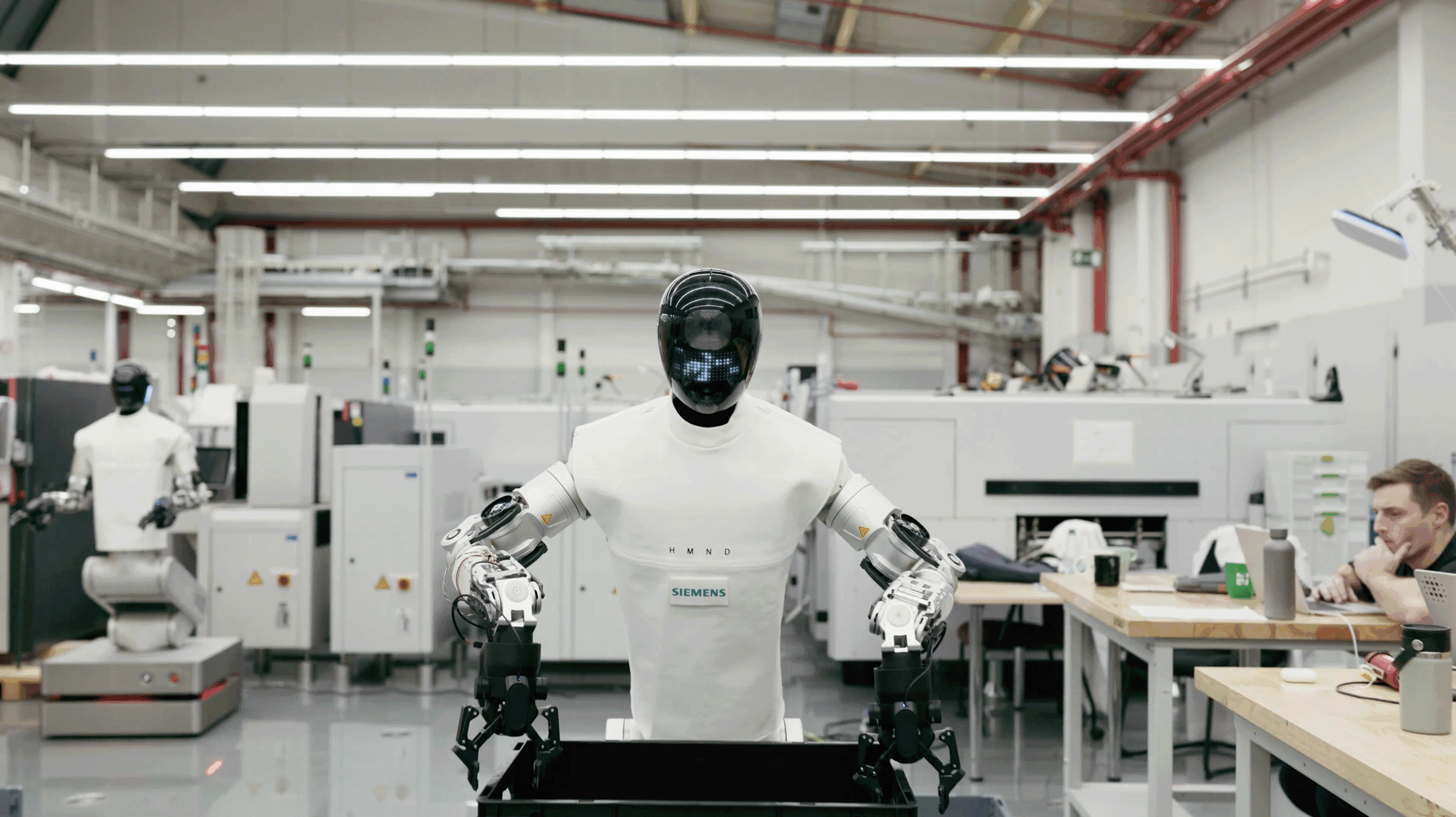
Founded in 2024 by Artem Sokolov, Humanoid is on a mission to build the most reliable, safe, and helpful humanoid robots. They will provide highly efficient services across various use cases and industries, starting with industrial applications such as pick-and-place use cases, visual checks and assembly in manufacturing.
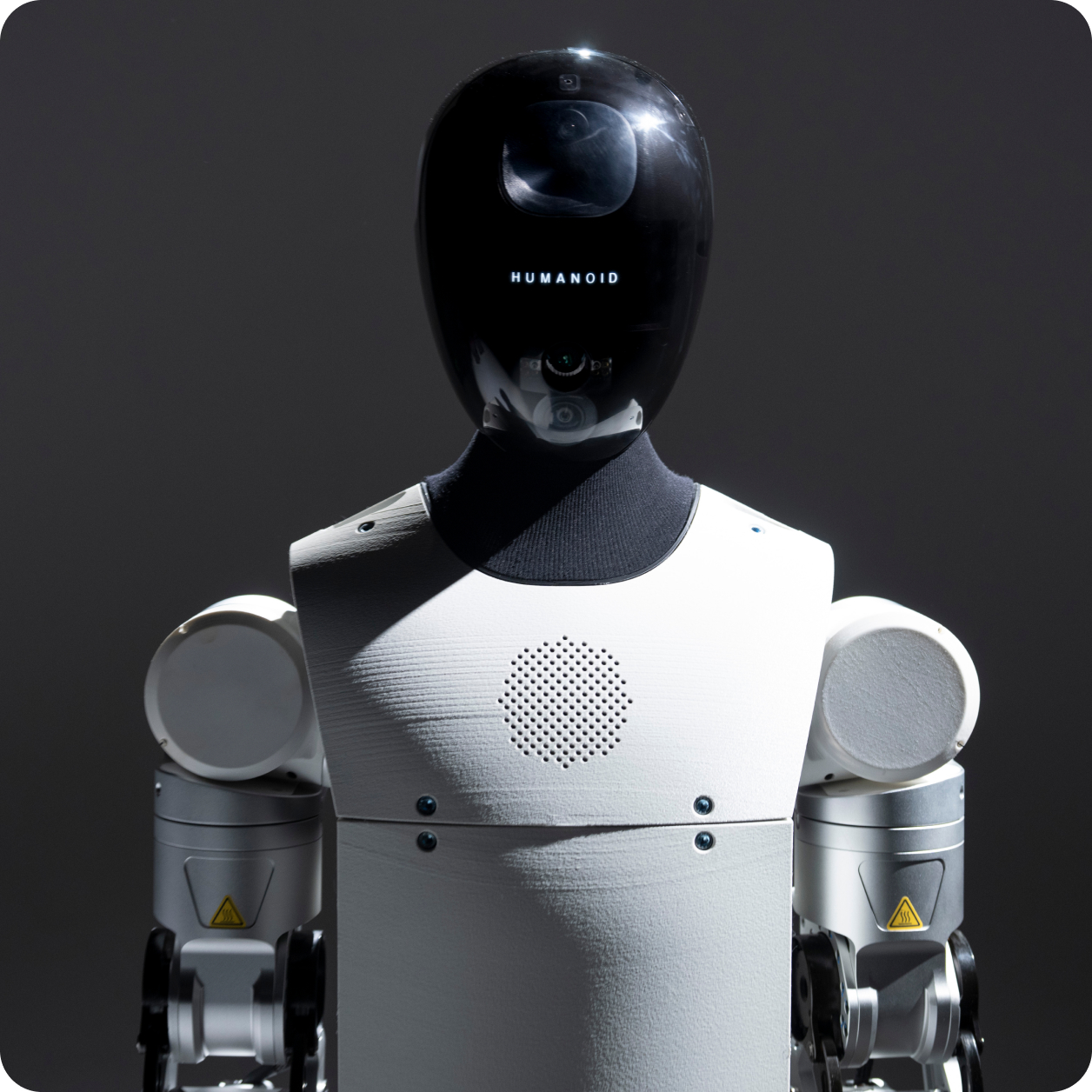
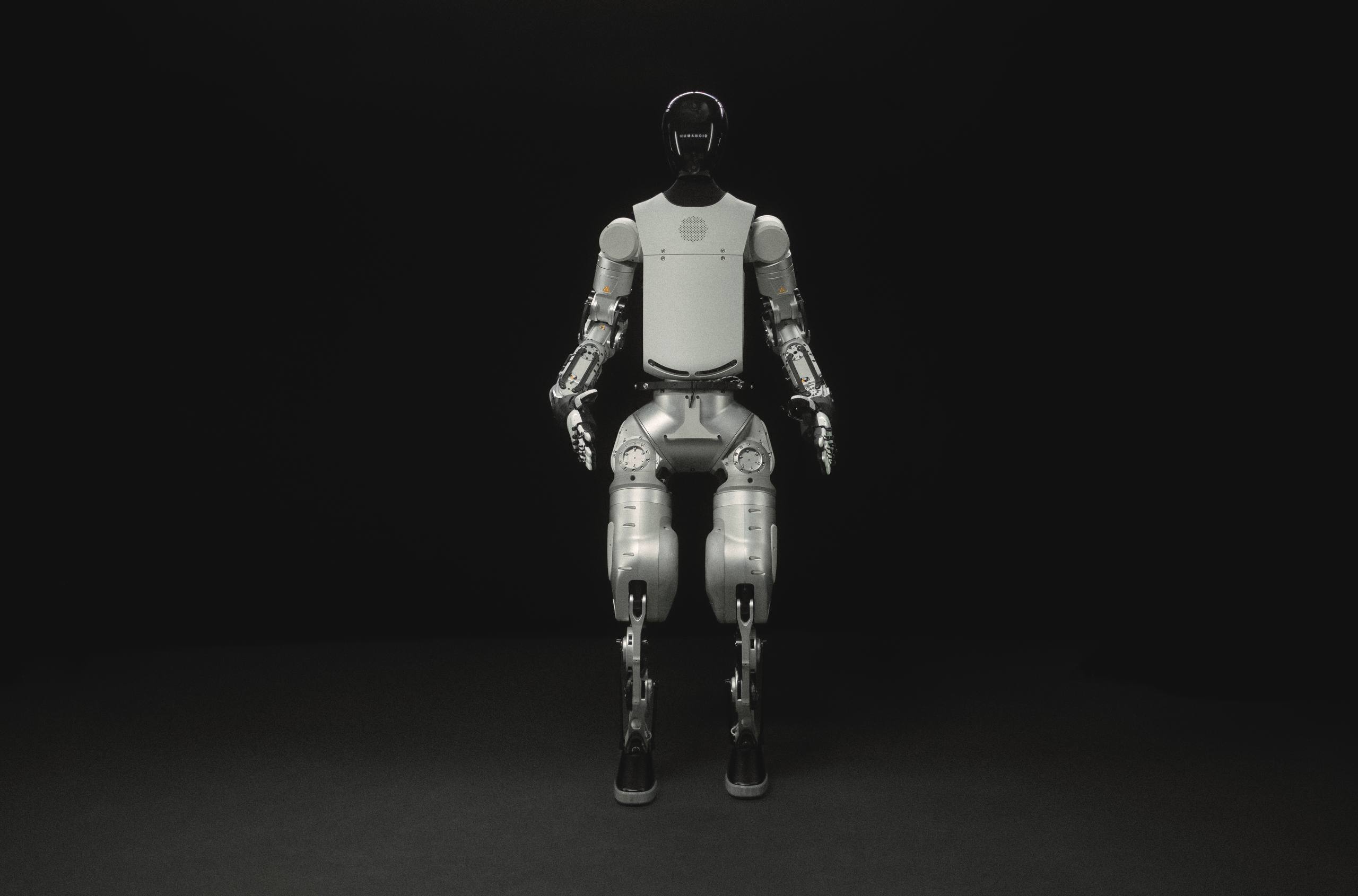
Humanoid’s latest innovation, HMND 01, is a next-generation labor automation unit designed to perform complex tasks at human-level or even superior manipulation speeds. HMND 01’s modular design offers flexibility in real-world deployment, allowing for quick reconfiguration to suit diverse tasks and environments. The company’s next milestone is the launch of its wheeled and bipedal alpha models, scheduled for later this year.
About Humanoid
Humanoid is a UK-based robotics innovation company dedicated to developing advanced humanoid robots that enhance human capabilities. Founded by Artem Sokolov in 2024, Humanoid brings together over 130 engineers, researchers, and innovators from top global tech companies. With offices in London, Boston, and Vancouver, the company is focused on building commercially viable, scalable, and safe robotic solutions for real-world applications.
For media inquiries, interviews, or further information, please contact: [email protected]
Deployment-Ready RL: Pitfalls, Lessons, and Best Practices
This text is a transcript of a webinar led by Kyle Morgenstein from the University of Texas at Austin for the Humanoid team. We’re sharing it on our blog to spread knowledge and help move the humanoid robotics industry forward. Please note that the views and information presented here are Kyle’s own.
Kyle Morgenstein, University of Texas at Austin
04:21 –> 05:00
As much as I’d like to sit here and give a lecture on proximal policy optimization and math, that’s not the goal today. Today we want to be pretty laser-focused on deployment on what does it mean to take our policies from simulation and get them to work on hardware.
05:00 –> 06:00
In the last couple of years, we’ve seen this really incredible success in legged locomotion, specifically in quadrupeds, using reinforcement learning.
Compared to model-based methods in the years prior we’re now able to do things that we thought were impossible. Learning entirely in simulation and deploying in the real world. So here we see some of the vision-based RL parkour work coming out of ETH Zurich, uh, without any kind of references or contact schedule, or any of the things that would have been required in model-based control.
We can put these robots sort of anywhere on Earth, and they’ll navigate them very effectively.
And then maybe my favorite video that’s come out in recent years has been this ladder climbing video. When I first saw it, I couldn’t believe what I was seeing. And of course, there are some modifications to make this problem a little bit easier. There’s the foot design that has the hook.
But the fact that we’re able to learn these really, really complex and agile skills in simulation and then deploy them in the real world, zero-shot is, I think, incredibly impressive.
06:00 –> 07:00
And we’ve seen this work as a standardized recipe now that works on any quadruped you can imagine.
When seeing these sorts of results over the last couple of years, I think there’s a fairly natural question that arises. Which is why we haven’t seen the same degree of success in humanoids?
So I want to show a video from last year. It was a humanoid parkour paper copying some of the best practices that came out of those ETH parkour papers. And to be clear, this is an incredibly impressive result as well. The vision-based policy adapting to its environment. Taking large steps, jumping over gaps. It’s still a very, very good policy, but the robot exhibits an ailment that we call “Drunken Robot Syndrome”. The gait is not quite confident. It’s taking all these small stutter steps to orient itself.
07:00 –> 08:00
And maybe this makes sense in simulation, given that our largest penalty that we ever give it is a termination for falling over, so the robot learns that it needs to stay upright at all costs, it’s taking these small steps to reorient itself.
There’s sort of an old adage that you don’t have to worry about dynamic balance if you can just step fast. And so we see this good enough transfer of a lot of these ideas that have worked so well in quadrupeds, but we don’t quite see the same level of precision and smoothness that we see in quadrupeds transfer over into humanoids. And so I’d like to spend some time today talking about what are those gaps in the deployment side that take us from the kinds of precise, agile policies we see in simulation, and turn them into behaviors on the robot.
To act as a foil for this, and maybe to contradict everything I just said, has been this demo from earlier this year where Boston Dynamics Electric Atlas did these really, really slick and smooth walking and running and dancing behaviors.
I think that there’s a pretty clear distinction between the video on the left and the right.
08:00 –> 09:00
The video on the left, the humanoid parkour, is using sort of the vanilla RL formalism. We’ve got our rewards, we hand-design, we hand-tune them, and we get the behavior that we want. On the right, these really nice behaviors are coming from reference data. So we have some motion capture data and retarget it for the robot, in this case, just kinematic retargeting, and then we can embed that in the RL formalism to get these kinds of really, really smooth behaviors.
And so I think that there’s sort of a conflict or tension between what we can do to take our vanilla RL formalism that works so well in the quadruped case, in the quadruped case we don’t require any additional references at all. Versus in the humanoid case, where we’d like to see the same kind of vanilla RL formalism work, but we haven’t really seen that at a deployment level.
And we’re starting to see a lot more of these reference and imitation methods embedded into RL to try and get that same degree of performance. That’s the starting point for what I want to talk about today.
09:00 –> 10:00
To that end I want to talk about actions-based design, the observation space, how you deal with model mismatch, things like your actor, your student-teacher, actor-critic methods, or asymmetric actor-critic. Some basic intuition for reward tuning, and then finish up with some talk about RL with motion references, and maybe how the field is evolving around it.
And you can see, I come from more of a control theory background, but have now turned my PhD into a learning PhD. And I’m strongly of the belief that to be able to do this well, you do need a very strong mix of learning and control theory. The intuition that you get from control theory is really indispensable. But the methods from learning are really what has enabled us to deploy these policies on even low-quality hardware very, very robustly. So, with that, let’s jump into it.
Starting with the action space. Typically, the action space that we use for these policies is a joint position residual.
10:00 –> 11:00
And so that looks like our PD control law at the top, so we have some desired joint position Q, and some velocity Q dot, and we track it. Now we take our action, we sample from our policy, parameterized by our weights. And our desired position, we say, is some reference position, maybe it’s the stance configuration for our robot, plus the scaled output from our neural network. And our desired velocity is always zero, so it’s gonna act like a regularizer for us.
This gives us our fairly standard control law. It’s still a PD control law, where we have some residual on top of a stance position, and that’s giving us the behavior that we want. This is sort of a virtual spring, it’s a damped virtual spring. It’s one way of thinking about it. But I’d like to convince you that there’s an alternative way of thinking about this that makes it a lot easier to deploy.
So, if you algebraically rearrange, if you pull the KAA term outside of the stiffness term, then you can treat this equivalently as a joint position residual.
11:05 –> 12:00
Or as a feed-forward torque with gravity compensation. And there’s the dimensions on the neural network output A don’t really care either way, but the way you look at these equations makes a big, big difference in how you tune them. Specifically when you go to tune the PD gains and the action scale A.
Given these two different representations of our action, we’d like to try and determine a pretty robust way of selecting our gains, both that we get good exploration in simulation, as well as good deployment on our hardware.
So the two terms we have are gravity compensation, as opposed to our feed-forward torque.
12:00 –> 13:00
Now, notice that even though these are algebraically equivalent lines, this is actually a multi-rate loop, so the Kp term, or the PD term, the first term in the bottom equation, is being updated at your firmware rate, so that could be somewhere in the thousands to tens of thousands of hertz.
Whereas the feed-forward torque term is only being updated at the policy control rate, which is usually around 50 Hz. Similarly, the joint position residual version of this. The whole control law is being updated at that firmware rate, but you’re only updating the action at that 50Hz.
What that means is that from the perspective of the PD controller, the action is quasi-static. It’s effectively not moving. If you’re updating your PD controller at 40,000 Hz, and your action only updates at 50. That’s more or less a static action for the PD controller to track.
So you can think of this either as a gain-tuning problem in the physical sense…
13:00 –> 14:00
…where we’d like to find a KP and KD such that we can converge on the position offset given to us by KA times A, and track that high rate, high fidelity to be able to achieve the desired position residual by the time we get our next control input.
Alternatively, we can think of this as adding some constant feed-forward torque onto this high-rate PD control law that’s smoothing out jitter or other disturbances from the policy. The difference that this makes is how you pick your gains, so you can either choose to… if you treat this as a PD controller in the typical control sense, then you’re gonna pick KP to be the square of your natural frequency, and use that KD to be critical damping and things like that. And the resulting gains are very, very high.
And so that will transfer to hardware, you’ll be able to stand the robot up no problem, because you’re treating it as a sort of physical problem. But you have substantially reduced exploration performance in simulation.
14:00 –> 15:00
If your gains are very, very high, then the effective bandwidth of the policy learn is lower, I’ll show that visually in a moment. But in the low gains case, where you’re in the bottom equation, where you’ve got your gravity compensation you’re allowing the policy to determine the bulk behavior, and you’re just using the PD controller as a bias towards stance.
So as opposed to treating the action as a position, you have to track exactly. You can treat the PD controller as just sort of a nudge at the beginning of training to keep you oriented around stance and to smooth out any jitter, and then the policy gets to learn the whole behavior around that.
So to depict this visually, let’s assume that at the beginning of training, our neural network is parameterized as a Bolivariate Gaussian, let’s call it one-dimensional for now. So its shape is gonna look like this black curve. So this is our distribution of actions that we may sample at the beginning of training.
Given some torque limit for our robot, we’d like to be able to understand what kind of exploration we can perform at the beginning of training.
15:00 –> 16:00
In the high-gain case, it’s going to be the red dotted lines. Because of our torque limits and our gains being as high as they are, when you do your random sampling over your untrained policy, the bandwidth, the range of values that you can sample, where you change the position of the actuator, or where you have a difference in output torque before it gets clipped, is very, very small.
It means that even though you’d like to sample from this normal distribution centered at zero, you end up oversampling and biasing your exploration at the torque limits. Because the high stiffness means that it’s effectively a bang-bang controller. So you’re exploring moving your joint one direction, you’re exploring moving it the other direction, but it’s hard to sample in between because there’s a very limited bandwidth that you’re able to resolve before you hit those torque limits when your gains are high.
When you have the lower gains, you’re able to resolve a much larger range of the distribution that you’re sampling from, this full normal curve.
16:00 –> 17:00
And so this gives you much, much better exploration, because now, let’s say if I want to sample on the right side of the distribution, and I’m over here close to but under the dashed blue line.
And then as opposed to that sample, let’s say half of that, but it’s still outside of the red dotted lines. That difference, when I’ve got low gains, I can track. The policy will take a different behavior, it’ll get to a different joint position. And we’ll get different rewards for it, we got good learning signal, we’ll update accordingly.
In the high gains case, in either one of those samples, I’m still gonna hit my torque limit, and so the joint’s still going to its maximum value. And so, you end up with a very jittery policy that is hard to do exploration with, and oftentimes won’t converge.
And so when you have lower gains, you tend to get much, much better training performance, uh, you end up with a smoother policy, it sort of helps the whole problem, not because it’s of the physical system.
If we go back to the equation for a minute. It’s not that, you know, one of these equations is more correct than the other, they’re both true.
17:00 –> 18:00
But if you think about it as a feed-forward torque law, as opposed to a joint position residual, it’s much, much easier to tune these parameters for exploration and simulation.
It’s not necessary to tune them as if it were a physical system that you must track as a standard PD control law, or you want to minimize overshoot and rise time and everything else like that. We don’t have to think about it in that control theoretic sense.
It’s better to think about it as an inductive bias against stance early in training. Really, what the action scale Ka is doing for you is – it’s controlling your learning rate, or your sampling rate, your exploration rate. So in Ka is very high, you’re going to oversample the torque limits.
But you’re going to more rapidly explore that space, whereas when Ka is low, you’ve got maybe lower magnitude exploration, so it can take longer to get momentum and energy in the weights of the neural network to output large values. But you get much smoother policies as a result.
19:00 –> 20:00
Just last thing to say on this visual, which is that when you have the high-gain case, you have limited bandwidth, like I mentioned, because you’re effectively doing bang-bang control. Uh, the effect of this when you’re training is that your actor standard deviation may increase, and in my opinion, this is sort of the most critical parameter to track during training, more than your terminations, more than your rewards, more than your success metrics.
If your standard deviation does not converge, then all of your training is sort of kaput. You’re not going to be able to reason about the effects of the policy with an increasing standard deviation, and I’ll talk more about that in depth in a little bit.
But that’s one of the big risks here, is if you have the high gains, even though it may be easier to start training, because you start with more torque at your stance configuration, the risk to the learning rate, the risk to the exploration is such that it’s generally not worth it. You generally do want the lower gains here.
I will talk about what that means on hardware in a minute. Um, but then, how do you pick those gains, heuristically?
This is sort of where we’re leaving well-principled theory land, and now going into what works in practice.
20:00 –> 21:00
This is just a heuristic. But the way I like to think about it is, given some range of motion at the joint and given some torque limit, we set Kp such that when we’re at one extreme of that range of motion, you can’t apply more than your torque limit. So this helps protect the system mechanically as well.
You can also modify this so that your spring is defined with respect to the center point. If you assume that you’ve got a symmetric range of motion. But I tend to find that it works better if you just treat it as… let’s say I’m at one extreme of my range of motion and I’d like to get to the opposite extreme of my range of motion. I set my Kp such that I would exhort maximum torque to cross over from one extreme to the other.
I think this works quite nicely in practice, because we very, very rarely, in a single step, want to transition from one extreme to the other. And so we’re generally using much less than this torque limit but we give the controller authority up to that torque limit to actuate the joint.
21:00 –> 22:12
But we don’t risk exceeding that. And then to set the damping for this. Again, just a heuristic, if you divide Kp by about 20, I find that works really nicely in practice.
27:00–> 28:05
Right, so then given this heuristic, I think there’s a fair question, especially that I typically get from the roboticists and mechanical engineers of how do I actually deploy a low-gain policy, because how am I tracking my joints otherwise?
So, a couple different ways to do it. First is a robot that we have in my lab, Spot, which we use for RL quite a bit. If you have high fidelity, torque or current feedback, and especially if you have output torque sensing, it is very, very easy to deploy a low-gain policy, because that feed-forward torque term can be tracked by your low-level control.
If you have that, that really makes life very easy. Spot is by far the easiest robot I’ve ever done RL with, because it has output torque sensing. And so that means that whatever, you know, torque I ask for, it’s gonna give me.
Like I mentioned, you can also anneal the gains to zero. As opposed to having to set a control law with low gains into your firmware, your low-level controller, you can just send a desired torque and If you have good enough torque tracking, that will work.
28:05–> 29:00
Although you do end up a little bit more susceptible to modeling errors, because you don’t have that PD controller to smooth out jitter from things like unmodeled joint friction or roadrunner show.
You can also train an actuator network if you have some reference policy to collect data with, like a model-based policy. That works quite well.
Or you can just distill it into a high-gain policy. So maybe you’re working with your physical system, and with low gains, you just can’t get it to track the torque accurately enough.
The reason we use low torques in sim is primarily for exploration. It gives us better exploration characteristics early in training, so we can learn more agile and more precise behaviors.
Once you have a policy that can provide you those references, you can then distill that with a student-teacher method into a policy that uses the higher gains that do work on your hardware, and then just track the desired joint positions accordingly.
29:00–> 30:00
And so there is some flexibility. What you train in simulation, it doesn’t always have to mirror exactly what you deploy on hardware, and we’ll talk more about some of those methods for distillation in a little bit.
Now let’s talk about the observation space.
I very, very often see people throwing wild things into their observation space that do not need to be there. All you need for your observation space are your velocity, your orientation, your joint state, your last action, and your command. That’s it.
You do not need anything else, you do not need a time history. If you need anything besides these features, you have to have a good reason for it. The one-time step should be all you need.
30:00–> 31:00
Even when you’re doing perceptive RL, then you can add and ensure a height scan or a depth image. Your command term, you can have multiple different types of commands. Velocity tracking is the common one, but this could also be a desired position and navigation, or a desired base height, or a desired footstep frequency, so that the command can still be somewhat expressive.
But in terms of the representation of the robot’s state. This is all you need. And for orientation, projected gravity is a much easier space to learn in than quaternions. I would recommend using projected gravity here as well.
The one exception, or a couple exceptions, are if you have a good reason for it. Some good reasons may be motion imitation. If you’re trying to learn some trajectory that you’ve already recorded, maybe through motion capture, then it’s reasonable to observe references for that trajectory that the policy is trying to meet, so that they’re joint targets at that point.
Or to observe the phase of the motion.
31:00–> 32:00
Similarly, in navigation, what made a lot of the animal navigation and parkour papers work through RSL was observing a clock that was counting down how much time remained in the episode, and this is really helpful to teach the policy that it didn’t need to throw its body into the goal region.
They could walk there much more steadily, because it knew it had time left before it was going to be reset.
Similarly for local manipulation, maybe you’d like to observe some objects or forces or goal positions for those objects. These are all good reasons to augment the observation space. But when you go to augment it, you do need to have a good reason for it.
Anything else is generally an excuse for poor system identification, so I see people add in things like the estimated ground friction. You don’t need that. Or estimating the desired foot height, you don’t need that.
Uh, in general, if you’ve got a well-identified system, you do not need anything additional to your observation space. So I’ll give an example of this. It’s sort of a cardinal sin I see in papers all the time related to linear velocity.
32:00–> 33:00
Uh, typically, especially for the… a lot of the Unitree robots, they don’t have a very good linear velocity estimator on the robot. So, there’s a couple different ways you can do this estimation. Of course, the more traditional way is just to use a model-based estimator, a common filter, a factor graph, etc. It might take a week or two to write out and test, and that’s fine, but it does help you substantially. If your goal is velocity tracking, it’s pretty important to know what your velocity is.
But there are alternatives, it doesn’t have to be a Kalman filter. So, for example, the paper on the diagram on the right is a learned velocity estimator. It’s a concurrent training, it’s a paper out of KAIST, very nice paper. This is very easy to implement. You could implement this in Isaac Lab in maybe an afternoon, train it at about the same time.
And this Learn module will give you an estimate of the linear velocity and foot height and contact state for the feet, and that’s all really helpful information to have. If you have that information available to you, that’s fine, you can use it.
33:00–> 34:00
But you should estimate it in some way. And then you can also do implicit estimation, so it’s become pretty common to use decoding heads, which we’ll talk more about in a little bit. But in some way, you should be embedding the linear velocity into your policy.
What you should not be doing is augmenting the observation space and hoping that it works. That’s what most people do. So, as opposed to having any kind of explicit or implicit estimate of the linear velocity, they’ll typically just add on an observation history. And say, okay, well, you know, I have all of my positions. And if I have enough time steps, then through finite differencing, the policy should just figure out how to reason about the velocity terms.
And it may, but this is less effective than using explicit estimation basically every single time.
Similarly, for recurrent architectures, there are reasons to use those architectures. We’ll talk about it in a minute. But lack of state estimation is not a good reason. If you have the ability and bandwidth to give yourself an estimate, you will be much, much happier. You will spend more time tuning the right things in your control policy.
34:00–> 35:00
You’ll have more time to spend with your spouse and kids. You’ll be a happier person, you’ll have lower stress. If you have the ability to train a state estimator, or use a model-based estimator, you should do it. It really, really, really helps.
I see it so often, these really complex architectures and papers that could all be resolved if they just had a state estimator. Model-based control will set you free. It does work.
There are times when it is okay to augment the observation space, or to violate Markov property, though the sort of context for everything we’re doing here in RL is as a Markov decision process, where we assume that one time step is sufficient to define your full problem space, but there are exceptions.
For example, maybe your task is acceleration-dependent, and you don’t observe your accelerations directly. So maybe you’re doing force control, and you don’t have IMUs on your end effectors.
Then you can use some amount of observation history or recurrent architecture, all the things I just said not to do, but when your task requires it, that’s okay.
35:00–> 36:00
You’re not making this assumption that you need it. It is true that through finite differencing, you can approximate these acceleration terms, and if your rewards are acceleration-dependent as well, then the policy will learn to reason about it.
Similarly, if your task requires memory, so if you’re trying to navigate a maze, then knowing that you took the left last time, and now you’d like to take the right, that’s pretty helpful. You do need to know that in your observation in some space.
Uh, so usually people do this by using a memory module, like neurovolumetric memory or some other technique like that, or using an explicit representation of your environment, like an occupancy map.
And so if you have access to this information, that will substantially help your training performance. But again, the idea is don’t just naively throw recurrent architectures or histories at the problem. I think the original RMA paper used 50 time steps. You do not need one second of history in 99% of cases. It’s usually overkill, and it usually just hurts your training performance.
36:00–> 37:00
Then the last one is when there’s some kind of fundamental constraint. So maybe you’ve got some non-rigid contacts that one time step is not enough to reason about how the trampoline may respond to your behavior, or you’ve got very, very poor quality sensors that you can’t extract the information you want.
If it’s possible, just fix the fundamental limitation, that will always help you more. Most of the struggle of RL is not actually a problem with learning, it’s the hardware, it’s the engineering, it’s the tooling, it’s everything around the RL. So, fix that first. It’ll make the learning problem much, much easier.
But if you’ve tried all of these things, and it’s still not working the way you expect, you can find better performance with these sorts of histories, but usually at the cost of conservatism in the policy.
37:00–> 38:00
Now I want to spend a little bit of time dealing with model mismatch.
Usually, like I mentioned, we’re treating this as a Markov decision process, but it’s specifically a partially observable Markov decision process, and so depending on where that partial observability comes from, we may need to change something fundamental about our learning architecture, oral neural network architecture that makes the problem tractable.
And so one example of this may be where you have informationally dense data type on your hardware, something like an image, but that doesn’t provide you an explicit representation of state, going back to control theory formalisms.
So, in your simulator, you have privileged information, ground truth, everything you could ever want about the position of your feet and the position of objects around you and everything else like that. But on your real robot, maybe you don’t have a depth scanner, or you don’t have a camera, or you have a camera only, but you don’t have any other way of, you know, you don’t have a LiDAR to track the position on the ground.
38:00–> 39:00
One really, really helpful way to deal with this is to use what’s called an asymmetric actor-critic. So, in simulation, where you have ground truth, you give the critic the most compact state representation that you can, you give it that ground truth information, because it’s very easy for the critic to use that to reason about the performance of the actor.
But then the actor only sees maybe still high information quality, but less explicit representation of an image, and that deploys better to hardware, because it’s what you have on your physical robot. This is sort of the dominant architecture at this point. Even problems where it’s not strictly required.
Everybody uses an asymmetric actor critic because it works really, really well. If you have extra information in your simulation about your center of mass, about your ground friction, about your foot height, all the things I said you don’t need in your observation space.
You do not need, and your actors’ observation space, it is not required on hardware, but if you provide it to the critic, it can give you a more accurate value estimate that can lead to more adaptive behaviors.
39:00–> 40:00
This is a fairly powerful formalism for dealing with limited information on hardware, but still being able to learn from all of the ground truth information available in simulation.
Next is student-teacher training. In many cases, we have a very complex task that requires certain information to complete. So, for example, this was the paper where they took the animal robot on a hike through the Swiss Alps. It was a nice science paper. To be able to do that, to adapt to all of these various terrains, the robot needs fairly accurate and precise information about the terrain through height scans.
But on the real robot, the LiDAR is sitting on the back of the robot, which is the opposite place you’d want it if you want to see the ground, and so the ground underneath the robot is fully occluded by the robot itself.
And so the question is, how do you resolve that? And one easy way to do it is through a student-teacher method. So your teacher assumes perfect information. All the things we just said you could provide to your critic, you can now provide to your actor as well in simulation.
40:00–> 41:00
And you train a reference policy, sort of an oracle, that is able to perform as well as possible in simulation, assuming perfect information, no sensor noise, no drift, everything else.
But of course, that’s unlikely to transfer to hardware, because your hardware does have all of these limitations, sensor, noise, drift, and everything else. And so you distill the teacher through DAgger or some other behavior cloning algorithm into a student policy that has the same characteristics as your real robot.
And this is really helpful, because I often see people look at the robot, they may have designed it themselves, they’re great mechanical engineers, they know all of the limitations, and so they bake that into the simulation, wanting to match it exactly. And then can’t learn anything because the model that they’ve used is so restrictive and has such poor fidelity and everything else, maybe that is what your real robot has.
But if you assume that in simulation at sort of step zero, then you’re never gonna learn as good of a policy as you’d like to, and so a good hack around that is to start with a teacher that you assume to be perfect in all of the ways that matter.
41:00–> 42:00
Learn a high-performance policy that way, and then use these tricks like student-teacher distillation to learn a student policy that is able to mimic the teacher as well as possible, given whatever constraints or limitations the student and real robot would have.
This is fairly common, especially in perceptive locomotion, where you want to use something like a perfect height scan representation, but on a real robot, all you have is a depth image, and so you can distill the depth image version from the teacher.
The one other time where people very often use this is exactly that depth image case. Simulating photorealistic images is still very, very slow and hard, even with these very powerful simulation environments. And so people typically train with the height scan, because you can easily, even on a consumer-grade GPU, you can train with 4,000 environments, which is pretty standard.
And then, using maybe the 256 or whatever your computer can support environments with the depth images, you distill your reference policy into the version that has a lot fewer environments.
42:00–> 43:00
Usually, if you tried to train with that few environments from the beginning, you wouldn’t be able to converge on any good behavior. You really do need that increased parallelism to have your increased batch sizes, to have a good estimate of the policy gradient.
But when you’re simulating depth images, you can’t really do that, and so it can be really helpful to learn a faster, more efficient representation of the state, like the height scan, and then distill that into the images that hopefully contain the same or similar information, but are too slow to simulate otherwise.
You can use student-teacher both because of limitations in your hardware, but also because of limitations in the simulator, and those are both valid reasons for doing student-teacher.
Then last, a more general, is decoding heads. You do this when you both don’t want to assume you can observe some parameter, but also still want your policy to be able to reason about it, so in this paper, for example, they used height scans. They did not want their real robot to require height information, whether through a depth camera or a LiDAR or anything else like that.
43:00–> 44:00
So instead what they do is they have a second output head from their policy. Their primary output head is controlling the robot, but the second output head is predicting what the height scan around the robot looks like, and in simulation, of course, you can access this.
And so it means that on the real robot, even though this is a fully blind policy, usually for these small quadrupeds, they struggle with stairs when blind, because they’ve got to pick their feet very high up. Through interacting with the environment, it’s able to estimate that there is a stair here, and navigate that even without explicit observation of the environment. That’s pretty impressive.
People also do this for, uh, linear velocity as well. So, as opposed to learning an explicit estimator of linear velocity, this is one way to get it implicitly, by training the network to have an additional output head to estimate linear velocity.
And if that converges during training, then you can argue that the weights of the latent space of the neural network has sufficient information to reconstruct the linear velocity.
43:00–> 44:00
Which you never actually need explicitly, as long as you’re confident that the policy knows about it and can reason about it and act accordingly. This can help with efficiency, uh, to help boost trap learning in sensor-denied environments as well.
55:00–> 56:00
So, next we’ll talk about curricula. Uh, they’re not strictly necessary, and there’s not a good science for how to do them yet, other than a few canonical examples that we’ll discuss.
But they can be really, really helpful when you have a hard task, that you’re finding the policy struggles to learn. This is especially true in manipulation. I think curricula are a lot better understood for manipulation than they are in locomotion.
For locomotion, the most common example of a curricula is your terrains. So you can see in this image, sort of at the left side of the image, we have these very steep pyramids and steep pits and high variability in the step height.
But if you look all the way to the left, then it’s much, much flatter. And so part of what we do with these curricula is we start with an easier version of the task, such that we can define a programmatic way of increasing the difficulty of the task as the policy learns. So as the policy becomes more capable, we should make the task harder until we get to the task we actually care about.
When we want to do, let’s say, stair climbing, you don’t start with stairs, you start with flat ground walking.
56:00–> 57:00
And then introduce stairs as you go throughout training, higher and higher stairs, until you’re doing the tasks that you care about.
And as a simple heuristic, if you define some success metric, in this kind of terrain-based environment, it’s usually the total distance traveled from reset. But if you find you get more than 75% success, then you should increase the complexity of the task and put the robot in a more difficult environment.
If you’re getting less than 50%, then maybe bump it back down to the easier environment so it can practice there. And so you can see that for this somewhat flat ground, where you just have the steps or the random variation. In this example, they have robots spanning the entire terrain space. In these much harder pyramids and pits they’re very much overrepresented in these easier levels, but the policy has not increased in capability enough yet to put it in the harder parts of the terrain.
So you update that programmatically, and various simulators have ways of dealing with this. Isaac in particular, has a nice curriculum interface for this.
57:00–> 58:00
Then another example of this was the Spot running demo. This was the other intern that I worked with, AJ Miller. And his work was in getting Spot to run at over 5 meters per second. The stock controller from the factory could do 1.25 meters per second, the fastest that I think they had ever seen internally at BD was 2.25 meters per second.
So we were able to over-double that. And a big part of that was the velocity curriculum. If you tell the robot when it doesn’t know how to move at all, that you want it to go 5 meters per second, then you give it a really big penalty, or basically no reward signal at all. And it’s very hard for it to learn that way.
And so instead, we started by asking for it to walk at up to 1 meter per second, and as it got better at that speed, then we asked it to go up to 2 meters per second, and then 3, and then 4, etc. So as the robot became more capable and gained skills, we asked it to do harder and harder tasks, to converge on the task we wanted, which was to maximize its velocity. But you don’t start with that version of the task immediately.
1:00:50–> 1:02:00
Now just a little bit on reward tuning and tuition.
This is also very much an art and not a science, so I’ll give you my perspective on it, what’s worked well for me. Other people may have totally different perspective on it, but I tend to approach reward tuning as a control theorist, more than as a strict learning person.
I think learning people tend to, uh, prefer sparse rewards, you know, success metrics, things like that. I think it’s oftentimes more helpful in legged locomotion to treat this as the cost for MPC. They’re not the same, obviously, their intuition is distinct. But I think it’s easier to start from that place of intuition and build on it into the learning side, then vice versa.
And so I want one more question real quick before I jump into that.
01:02:20-01:03:00
The general way that I think about it is that the weight loosely encodes the order that you want to be learning your different tasks. So if you have some very large, high, positive weight rewards, those are the things the policy will learn first. Because it’s going to drive TD error, so the critic will try to resolve that and guide the policy to minimize TV error, and that’s what ends up being learned first as a skill.
When it’s possible, and it’s not always, but when it’s possible, try to factor rewards into somewhat independent actions. So, for example, while my foot clearance, while the height of my foot is above the ground, it’s certainly dependent on how fast I’m going in some sense.
01:03:00 –> 01:04:00
I can tune them as independent knobs. I can say, oh, I’d like to walk at 1 meter per second, and whether I’m picking my foot up 10 centimeters versus 15 centimeters from the ground, that’s sort of independent of my choice of desired base velocity.
They are coupled through the dynamics, but you can think of them as being independent in the sense, as opposed to two rewards that maybe are more intimately tied.
In general, I split all of my rewards into task rewards versus penalties. So your task rewards tend to be large and positive rewards that define the bulk behavior. If you squint, what is the robot doing? Is it velocity tracking? Is it navigation? Is it goal? Is it reorientation about some goal? Etc.
It’s pretty common to do, like, a squared exponential or a normed exponential as the kernel for these. So it looks like a bell curve, so it gives you a nice, smooth gradient to minimize some error. Usually you define an error for your task, and then you have this squared exponential to minimize it with a positive reward.
01:04:00 –> 01:05:00
People occasionally will also use the L1 kernel instead of L2 for the exponential. That gives you more of the absolute value if you were to plot, you know, the E to the negative absolute value of X. You get a much spikier function.
You don’t want all of your rewards to look like that, because you’ll end up with a lot of jitter, because the policy can never converge on a low error state. Because it’s so spiky. But for some rewards where you really want to make sure you push it to minimize err as much as possible, it’s a much more aggressive kernel.
So an example of that might be if you’re trying to minimize error between some desired base height for your robot, you typically want to use an L1 kernel instead of L2, because you’ll get much more high-fidelity tracking, but it isn’t the dominant task reward, your velocity tracking usually is.
And so you’re able to avoid the kind of jitter you might see if you only use L1 exponentials. While still getting high fidelity tracking performance. And this is some of the reasoning there.
If you look at that compared to the inverse, the inverse is 1 over 1 plus X squared, where you’re trying to minimize X squared, that is almost the exact same shape as a bell curve.
01:05:00 –> 01:06:00
So a lot of these have very, very similar shapes and characteristics. And currently, squared exponentials are the kernel that people most typically use.
For regularizing penalties, this is just minimizing some L2 norm, so minimize energy usage, minimize joint accelerations, minimize violations beyond your desired joint limits if you’re not enforcing them as a strict penalty, or as a strict termination condition.
These typically have much smaller weights. And the idea is that you start by learning all of your task words, you enforce that the policy will learn the bulk behavior that you want, but it might look a little ugly doing it. At that point, your mean total reward typically converges, because most of the reward that you’re getting is coming from these large positive task rewards.
And then you let it train for 2 to 5 times longer than it looks like you need to, longer than it looks like it’s converged. And that’s what really gets all these regularizing penalties to shake out the behavior to make it much, much smoother.
I very often see, when you look at more learning-style papers of the Atari games, whatever, they’re trying to maximize their success rate.
01:06:00 –> 01:07:00
And the minute that they get the high enough success rate that they want, they stop training. For us, when we’re trying to deploy this on real hardware, you typically want to train it a good deal longer than that, because the result is a much, much smoother policy, and this goes back to where the policy’s learning from.
It’s not just that you’re trying to maximize your rewards, but it’s specifically that you’re trying to minimize the temporal differencing error from the critic. Without going too much into the theory, all that means is if the critic can expect the reward or penalty, then it’s not going to learn from it.
And so, early in training, all of the error between what the critic expects and what’s actually happening is coming from these high-magnitude task rewards, but later in training, when it looks like the reward is converged what’s actually happening is there’s still TD error coming from the critic for these smaller magnitude regularizers.
And minimizing that takes a lot longer than you’d expect. And so, usually, for the rewards I have tuned, when I deploy them on hardware, and this is true whether Quadruped humanoids or across modality, I’ll train for 20,000 to 30,000 iterations.
01:07:00 –> 01:08:00
You can minimize that if you have a lot more parallel environments. When I do that, I usually have about 4,000 environments, which works well on consumer GPUs. But if you have a nice server rack of H100s burning a hole in your pocket, then, yeah, go to 32,000 environments. Train on multi-GPU, and you’ll converge much, much faster. And by faster, I mean in fewer number of iterations.
But you still do want to let it converge and then sit there for a while to get the nice SIM-to-real transfer.
Then last note here: ensure that you always have a net positive reward, uh, otherwise, if the net reward is negative and the robot has some way of terminating the episode, for example, by making contact with the ground, it will learn to kill itself. If life is suffering, then there’s an easy way out.
Instead, if the reward is always net positive, then it will never do that. It will always learn the task that you want, or at least it will learn to maximize the length of the episode, because there’s always positive reward to be had. I often see people using a termination penalty to try and prevent this from happening.
01:08:00 –> 01:09:00
I find it much harder to intuit and tune when termination penalties are applied, and so I typically prefer to use a live rewarder and a live bonus to push the net reward to always be positive at the beginning of training, to make sure that the robots don’t learn early termination.
01:18:30 –> 01:19:00
Okay, so next, some commons. So, you asked about the common rewards. This is very similar to what we see in the paper that was linked in the chat from Spot running, and you can see it’s very clearly split into task rewards, which are positive, versus the penalties, which are the negatives.
I’m not gonna go into these explicitly, just in the interest of time. They’re fairly straightforward and somewhat uniform in the literature.
I will say that, again, as reward tuning is more of an art than a science, there are small changes, for example, the L1 vs. L2 kernel, that do make a big difference.
01:19:00 –> 01:20:00
It doesn’t seem like it should, but that choice can pretty drastically change how smooth your resulting policy is, and that’s mostly a matter of trial and error. So I, at this point, like I mentioned, I’ve got this set of rewards that I really like that works well for me, so I use them everywhere.
But to get those rewards, there wasn’t really any first principles reasoning to get there. It is fairly empirical and heuristic. It takes practice on your robot to get the right formalism and weights and kernel for your robot specifically.
But these are the general things, the parameters, the knobs I like to have to be able to tune, to be able to get the kinds of behavior that I want for legged locomotion.
And of course, this is a velocity tracking formalism, but you can swap this to navigation pretty easily just by changing out some of the task rewards.
Okay, I would say, the most important, uh, parameter in all of training for RL. When we train our policy,the policy doesn’t actually give us an action, it gives us a mean and a standard deviation.
01:20:00 –> 01:21:00
So we can parameterize some multivariate Gaussian that we sample, and that’s where our action comes from.
At runtime, we’re just taking the mean of the distribution, but for training, the standard deviation is vitally important to be able to do this sampling procedure. When you are training, first and foremost, make sure that you are logging the standard deviation. If you are not logging your standard deviation, you do not know how well your robot is working, doesn’t matter what the rewards look like, doesn’t matter if your loss converges.
If you don’t know your standard deviation, you don’t know how good your policy is. Once you do have your standard deviation logged, make sure it is decreasing. It should not go to zero, but it should converge from whatever its initial value, usually 1, to some smaller value. This is the most important thing to do your RL tuning.
If this value does not converge, nothing you do matters, because the policy does not know the effect of its actions. The standard deviation is the policy telling you how confident it is that its action is going to be a good one.
01:25:00 –> 01:26:00
And then last, just to finish up here, let’s talk about RL with Motion references, because they’re becoming very popular. I think for good reason. If we want to think about task specification as a spectrum, on one end, we have behavior cloning, we have an exact teleoperated example of what we want our robot to do, and we’d like the policy to exactly mimic or clone that behavior. We have fully specified our task, it is very, very rigid, but we have a great deal of control over what the robot does, because we’re just showing it.
On the opposite end of the spectrum, you’ve got the vanilla RL formalism, especially when you only have a few rewards where you aren’t over-prescribing your rewards. You have a very, very flexible task specification. If your only reward is track velocity and minimize energy, then the robot will find whatever unnatural gate to be able to do that. But it’s got maximum ability to explore and flexibility to achieve the task.
01:26:00 –> 01:27:00
In practice, though, we don’t want the most flexible version of this, because we know from first principles how our robot should behave. We’ve got some desire for what that motion looks like, how smooth it is, etc.
And so you can increase the specification of the task. Either by adding more rewards by hand or, what’s even easier to do is to use motion references. And so these motion references, as we see in this video, give the robot a sort of more in the style of behavior cloning, a reference for what it should do, its joint angles, its base, you know, state, etc.
But because you’re still training it with the reinforcement learning formalism, it has a great degree of robustness to things like ground friction, or center of mass, or if different inertial properties, things like that. Then in behavior cloning, if you go out of distribution, where you don’t have data, you expect performance to degrade rapidly, whereas with RL, because we can generate data at train time with this wide variety of real-world conditions.
We can start with fairly simple and very small amounts of reference data, and expand that into a very robust policy that works on hardware.
01:27:00 –> 01:28:00
So it’s part of why we’re seeing it work so effectively. There’re two main different ways to do this, either GAN or discriminator-based versus feature-based. So, AMP, Adversarial Motion Priors, is the canonical example of GAN-based. It’s very scalable to diverse environments, you’re just estimating the style, or you’re trying to mimic the style of the distribution of your reference data.
But because it’s a discriminator trained in parallel with the actor, it can be very difficult to train and hard to interpret. Just in general, I feel like the intuition for training discriminators is quite difficult, even though they work well in practice once they’ve been trained.
Compared to feature-based, this is more like training an auto-encoder on your reference data, and then using latent conditioning to get the behavior you want.
This tends to be much easier to train and interpret. You can get nice compositionality with it. The motion imitation itself is much higher quality and higher fidelity, much lower joint tracking errors, for example. But it doesn’t generalize nearly as well.
01:28:00 –> 01:29:00
So depending on your task, whether you’re trying to mimic one specific behavior that you want to have high fidelity on, you would use feature-based. Versus if you just want the style of natural gait walking, for example, then GAN-based is gonna typically do better for you in that setting.
And then, just to wrap up, summary. Lower PD gains will give you better exploration and you should enforce everything as a soft constraint. The hard constraints will hurt you. If you start with a perfect model, then you know the capabilities of your task setup and your rewards, and then you add realism iteratively until you converge on your real system model.
You should train a lot longer than you think and use less domain randomization than you think.
Please, use a state estimator, your life will get easier, I promise.
The hyperparameters that you get with PPO, generally, at this point, are good. We call them Nikita magic numbers, because they are tuned well, and they work.
But the most important takeaway, I hope, that you got from this talk: there is no replacement for principled system identification.
01:29:00 –> 01:30:00
If you have a good and well-identified system, RL is not hard. If you are struggling with RL, most of the time when I’ve seen this at various labs, it is because they do not have good system identification. This is the most critical thing to make RL work in practice, the difference between “drunken robot syndrome” versus the really, really smooth and slick demos is system identification. The better you know your robot, the better RL will treat you. And so I think teams that spend the time and effort to do good system identification will be rewarded with better performing RL, and that’s the most important thing I could possibly impart.
Top Startup Breakthroughs and Products to Watch
1. New Atlas Boston Dynamics
In April 2024, Boston Dynamics retired their hydraulic Atlas model and introduced a new, fully electric version designed for practical, real-world applications. This transition marks a move from research and development to commercial viability.
The new electric Atlas builds on Boston Dynamics’ extensive experience in robotics innovation, including their success with other robots like Spot and Stretch. The company aims to address challenging industrial needs with this advanced humanoid robot.
Boston Dynamics notes that the robotics landscape has changed dramatically since they began working on humanoid robots a decade ago. They are now leveraging their experience in successfully commercializing robots to develop Atlas into a valuable solution for various industries.
Hyundai, having invested in Boston Dynamics, is collaborating on the development of the new electric Atlas robot and will be among its initial users, testing the technology in their own operations.The automotive company’s manufacturing facilities will serve as a testing ground for new Atlas applications, particularly in next-generation automotive manufacturing.
2. Tesla’s Optimus (United States)
According to Elon Musk’s statement at Tesla’s annual shareholder meeting in Texas earlier this year, the Optimus humanoid robot is set to enter production next year despite still being in development. Musk projected that Tesla could deploy “a few thousand” of these robots in its own factories. This indicates Tesla’s commitment to integrating its robotic technology directly into its manufacturing processes, potentially as a real-world testing ground before wider commercial release.
Elon Musk has announced that Tesla may begin selling its humanoid robot, Optimus, as early as the end of 2025, according to Forbes. Musk also made a bold prediction about the potential impact of this product on Tesla’s valuation, suggesting it could help drive the company’s worth to $25 trillion. This statement underscores Musk’s confidence in the Optimus robot’s market potential and its significance to Tesla’s future growth strategy.
Tesla’s Optimus Gen 2 humanoid robot was a major attraction at the World Artificial Intelligence Conference (WAIC) in Shanghai, drawing large crowds despite being displayed in a glass case without live demonstrations. The 5’11”, 121-pound robot, which Tesla claims can perform routine tasks like folding laundry, represents the company’s significant investment in robotics technology.
While Elon Musk has suggested the robot could be ready for initial launch by the end of 2024 or 2025, with a projected price between $25,000 and $30,000, no official timeline or pricing has been confirmed.
K-Scale Demo
3. Astribot (China)
Shenzhen-based Astribot, founded in January 2022, specializes in developing consumer humanoid robots and integrated bionic robots. The company operates in the fields of Artificial Intelligence, robotic process automation and robotics. Astribot secured an undisclosed amount in Series A funding in June.
The Astribot S1, presented at the World Robot Conference in Beijing on August 21, is a versatile humanoid robot with a human-like upper body mounted on a wheeled base, allowing for dexterity and practicality. This robot is capable of executing a wide range of tasks, from household chores to delicate manual operations, showcasing its advanced sensory integration and adaptability.
K-Scale Demo
4. Mentee Robotics (Israel)
Mentee Robotics, a Tel Aviv-based startup founded in 2022, is developing an advanced humanoid robot combining robotics, sensing, and artificial intelligence applications. The company has raised $17 million to date and aims to deploy a production-ready prototype by Q1 2025.
Mentee Robotics was founded by a team of AI and computer science experts. The company is led by Prof. Amnon Shashua, a world-renowned figure in AI and founder of Mobileye. He’s joined by CEO Lior Wolf, formerly of Facebook AI Research, and Shai Shalev-Shwartz, a distinguished computer scientist and machine learning researcher.
The company’s flagship product, Menteebot, is designed for versatility across various environments. It promises advanced dexterity for both household and industrial tasks, relying on innovative camera-only sensing technology instead of traditional methods like LIDAR or radar.
While the company doesn’t spell out its targeted industries, Menteebot’s potential applications are likely to require dexterous manipulation and adaptable task performance. In the industrial sector, it could be deployed in manufacturing plants and wa
K-Scale Demo
5. K-Scale Labs (United States)
Founded in 2024, K-Scale Labs is a pre-seed company based in New York. It has raised $500K to date.
As a Y Combinator startup, the company is focused on developing humanoid robots that can handle tasks people often find boring or tedious. With an open-source design being released to the public, these robots are capable of walking, talking, and manipulating objects.
The active founders of K-Scale Labs include Benjamin Bolte, a roboticist and machine learning researcher who has worked on robots at Tesla and Meta. Pawel Budzianowski brings expertise in machine learning, with experience in both research and production, having previously served as the head of ML at PolyAI and earned a PhD from Cambridge. Matthew Freed has a background in mechanical engineering and artificial intelligence.
According to a blog post by co-founder Pawel Budzianowski in August 2024, the team at K-Scale Labs is anticipating a rapid increase in affordable and functional humanoid robots across various settings, from labs to homes. They are committed to open-source development, ensuring that advancements in robotics are accessible to the public.
Their mission is to create a robotics platform that allows enthusiasts and researchers to experiment and innovate with ease, similar to how GPT-2 transformed NLP.
K-Scale Demo
6. Galbot (China)
Galbot, a Beijing-based robotics start-up supported by the Hong Kong government, plans to compete with global tech giants in the humanoid robot market. Co-founder Yao Tengzhou stated that Galbot will use Hong Kong as a gateway to introduce its robots to international markets, particularly in developed regions with high labor costs.
GalaxyBot Robotics Co., Ltd. has completed a 700 million RMB ($96 million) round of financing in June, attracting major investors like Meituan-Dianping, BAIC Capital, and SenseTime.
The company focuses on developing advanced embodied intelligent robots for household use, leveraging their expertise in AI and robotics to enhance adaptability and functionality.
According to the company website, the Galbot G1 robot can assist with various tasks at home, such as cleaning, organizing and fetching items. In retail, it handles stocktaking, restocking and delivering goods in stores and malls. In terms of manufacturing applications, it sorts and packages parts, handling materials of different textures and shapes.
Hong Kong Investment Corporation (HKIC) has partnered with Beijing-based humanoid robot start-up Galbot in July 2024 to establish the HK-Galbot Embodied AI Lab. This collaboration aims to boost Hong Kong’s AI industry, with plans for Galbot to explore applications for humanoid robots in sectors like retail and tourism, potentially leading to an IPO.
7. The Humanoid Robot Innovation Center (China)
The Humanoid Robot Innovation Center, located in Tongzhou, Beijing, is part of China’s broader efforts to advance its robotics technology. This startup is developing prototypes of universal humanoid robot bodies, operating across the IT, manufacturing and robotics sectors.
The center is an initiative of SUPCON, a publicly traded company in China that has recently entered the humanoid robotics space. SUPCON has unveiled its own humanoid robot, Navigator α, which stands 1.5 m tall and weighs 50 kg, according to The Robot Report. This robot features advanced capabilities, including dexterous hands with 15 finger joints and a fingertip force of 10N. SUPCON plans to integrate large-scale AI models into its robots and is focusing on bridging the gap between technological research and industrial demand.
The center recently secured $48 million in funding from Beijing Yizhuang Investment Holding. Xu Bin serves as the general manager, though details about other founders are not provided.
A key initiative is the planned establishment of a training complex in Shanghai, aiming to simultaneously train 1,000 robots by 2027. Initially, the facility will accommodate 100 robots.
8. Nvidia’s Project GR00T
NVIDIA has unveiled Project GR00T, a foundation model for humanoid robots, in March 2024 along with significant updates to its Isaac robotics platform.
The company introduced Jetson Thor, a new computer for humanoid robots based on the NVIDIA Thor system-on-a-chip, designed to handle complex tasks and interactions.
NVIDIA is collaborating with leading humanoid robot companies to build a comprehensive AI platform, aiming to accelerate development in the field of embodied AI.
The Isaac platform updates include new tools for robot training simulation, generative AI foundation models, and GPU-accelerated libraries for perception and manipulation, all designed to enhance robot development and performance.
Nvidia imagines GR00T as an AI model that will serve as a “brain” for robots. This ambitious project aims to enable robots to acquire new skills and tackle diverse tasks adaptively. Nvidia researcher Linxi “Jim” Fan described the initiative as their attempt to achieve embodied Artificial General Intelligence (AGI) in the physical world.
The Future of Work: How Humanoid Robots Will Revolutionize Industries
What if this new generation of technology is actually a great thing?
While alarmist rhetoric and fear-mongering headlines about humanoid robots threatening jobs are abundant, such fears may be misplaced. In reality, artificial intelligence and robotics technology are advancing rapidly, paving the way for humanoid robots to take on increasingly sophisticated roles across various sectors.
Rather than simply replacing human workers, these expanding capabilities promise to revolutionize industries from manufacturing to healthcare, potentially creating new opportunities and enhancing productivity in ways we’re only beginning to imagine.
Recently, rapid advancement of humanoid robotics has prompted some U.S. lawmakers to express concerns about potential security risks and economic implications. As widespread adoption may be imminent, now is the crucial moment to explore potential use cases for these advanced machines and consider their far-reaching consequences for the global workforce and international relations.
In HumaNoid, we are observing firsthand the transformative potential of this technology. Advanced humanoid robots are not destined to replace human workers entirely. Instead, they are poised to revolutionize industries by complementing human skills and addressing critical labor shortages in hazardous environments.
The dawn of a new workforce
Humanoid robots represent a leap forward in automation technology. Unlike their predecessors, these machines are designed to navigate complex, human-centric environments with unprecedented dexterity and adaptability. This makes them ideal for tasks that were previously too dangerous or impractical for traditional robots.
Consider the manufacturing sector, where humanoid robots are already making significant inroads. At automotive plants, these machines can work alongside human employees, handling heavy components and performing repetitive tasks with precision. This not only increases efficiency but also reduces the risk of injury to human workers.
Another compelling use case is in disaster response. When earthquakes, floods, or industrial accidents occur, humanoid robots can be deployed to assess damage and perform rescue operations in environments too hazardous for human first responders. This capability was demonstrated during the 2011 Fukushima nuclear disaster, where robots were used to explore contaminated areas and assist in cleanup efforts.
Addressing global labor needs
One of the most promising aspects of humanoid robot technology is its potential to address critical labor shortages across various industries.
According to the latest data, there are currently 8.1 million job openings in the U.S. but only 6.8 million unemployed workers available to fill these positions. Up to 70% of these job openings are essential roles in warehouses, manufacturing, transportation, and retail.
In many developed countries, aging populations and declining birth rates are leading to workforce gaps in essential sectors. By 2050, the proportion of the global population aged 65 and above is expected to rise to 16%, up from 10% in 2022. This means that more than one in six people across the globe will be over 65.
In healthcare, for instance, humanoid robots could be deployed to assist nurses and caregivers, performing tasks like lifting patients or delivering medications. This would allow human healthcare workers to focus on more complex, empathetic aspects of patient care.
Similarly, in agriculture, humanoid robots could help address labor shortages during harvest seasons. Their ability to navigate uneven terrain and handle delicate produce with precision makes them ideal for tasks like fruit picking or crop monitoring.
Emergence of new job categories
While the integration of humanoid robots will lead to some job displacement, it’s equally important to recognize the new job categories this technology will create. As with previous technological revolutions, the rise of humanoid robots will generate demand for workers with specialized skills.
The rise of humanoid robots will create a demand for various new job categories. We’ll need robot trainers and programmers to teach these machines new tasks and optimize their performance. Maintenance technicians will be crucial to keep the robots in good working order. Ethics and safety specialists will play a vital role in ensuring the responsible deployment of this technology. Additionally, human-robot interaction designers will be necessary to create intuitive interfaces that facilitate seamless collaboration between humans and robots. These emerging roles highlight the shift towards a workforce that combines human expertise with robotic capabilities.
Moreover, as robots take on more dangerous and repetitive tasks, human workers will be freed to focus on roles that require creativity, emotional intelligence, and complex problem-solving – skills that remain uniquely human.
Creating a workforce for the AI era
As we integrate humanoid robots into our industries, striking a balance between technological advancement and workforce considerations is crucial. This requires a multifaceted approach combining retraining programs, gradual deployment, collaborative design, and ethical guidelines. Companies and governments should invest in upskilling workers for the robot-augmented economy, while phasing in robotic systems to allow for adaptation.
Involving workers in the design and implementation process can lead to more effective integration and reduce resistance. Simultaneously, developing clear ethical guidelines for robot use, addressing privacy, safety, and job displacement concerns, is essential. By thoughtfully managing this transition, we can harness the benefits of humanoid robots while mitigating potential negative impacts on the workforce.
The human touch in a robotic world
Despite the advanced capabilities of humanoid robots, there will always be a need for human oversight and intervention. In fact, the most successful deployments of this technology will likely be those that leverage the strengths of both humans and robots.
For instance, in a manufacturing setting, humanoid robots might handle the physical assembly of products, while human workers focus on quality control, process improvement, and customer interaction. This symbiotic relationship allows for increased productivity while maintaining the flexibility and problem-solving capabilities that humans excel at.
New era of human liberation
As we stand on the brink of this technological revolution, it’s natural to feel a mix of excitement and apprehension. However, by approaching the integration of humanoid robots thoughtfully and ethically, we have the opportunity to create safer workplaces, address critical labor shortages, and unlock new levels of productivity and innovation.
The future of work is not about humans versus robots, but rather humans and robots working together to tackle the challenges of the 21st century. As leaders in industry and technology, it’s our responsibility to guide this transition in a way that benefits workers, businesses, and society as a whole.
At HumaNoid, we see the integration of humanoid robots into our workforce as more than just technological advancement; it heralds a profound shift in our societal structure and human potential.
This idea is reflected in our vision: we believe in a future where humans and machines together build a new history filled with knowledge, inspiration, and spectacular discoveries.
As these advanced machines take on repetitive, dangerous, and undesirable tasks, we stand on the brink of a new era of human liberation.
This technological revolution is not only promising to address critical labor shortages in essential industries– it will also help liberate individuals to pursue more fulfilling and creative endeavors.
Our vision for what humanoid robots can be extends beyond mere efficiency gains, encompassing a future where universal basic income becomes feasible, poverty is significantly reduced, and human beings are empowered to choose their life’s work based on passion rather than necessity.
By deploying humanoid robots in hazardous or monotonous environments, we not only safeguard human well-being, but also pave the way for a society where abundance is the norm and human potential can be fully realized.
Just as many are becoming disenchanted in the limits of capitalism, this new AI era is already ushering unprecedented advancements in knowledge, learning, and discovery. It could be just the thing to allow humans and machines to collaboratively build a future of shared prosperity and innovation.
Top-Funded Humanoid Robot Startups
Top-funded humanoid robot startups span across the globe, from the U.S. and Norway to China and Canada, showcasing a broad range of innovations aimed at transforming industries like manufacturing, logistics, and even household tasks.
What sets these companies apart is their focus on tackling labor shortages, improving productivity, and creating general-purpose robots that can seamlessly integrate into human environments. Startups like Figure Robotics and Agility Robotics are revolutionizing logistics with AI-powered humanoids, while companies such as 1X and Zhiyuan Robotics are focusing on household and industrial applications.
Despite different geographies, the common thread among these ventures is their drive to automate monotonous and labor-intensive tasks, aiming to reshape the future of work and daily life through human-like robots.
1. Figure AI (United States)
Figure Robotics is an AI robotics company based in Sunnyvale, California. The company was founded in January 2022 by Brett Adcock, who previously founded Archer and Vettery.
In February 2024, Figure Robotics raised $675 million in Series B funding, bringing their total funding to $854 million. The investors include major tech companies like NVIDIA, OpenAI, Microsoft, and Intel Capital.
The company is developing a multi-purpose humanoid robot called the Figure 02, which is designed to have the dexterity of the human form and leverage cutting-edge AI to take on tasks across manufacturing, logistics, warehousing and retail. The company sees a major opportunity in addressing the growing labor shortages, particularly in manual and repetitive jobs. By developing general-purpose humanoid robots, Figure Robotics aims to automate these types of tasks and transform the labor-based economy. Their goal is to drive down the cost of labor and enable a higher standard of living where people can pursue more purposeful work.
Key technical challenges the company is focused on include system hardware, reducing unit costs through high-volume manufacturing, ensuring safety and developing advanced AI capabilities to enable autonomous operation in complex real-world environments. Figure Robotics is not pursuing military or defense applications for its robots.
Introducing Figure 02
2. Agility Robotics (United States)
Founded in 2015, Oregon-based Agility Robotics develops bipedal walking robots designed for efficient and agile real-world applications. These robots feature human-like capabilities, enabling them to work alongside people with minimal programming and adapt to various environments, including offices, factories, and homes while automating tasks across diverse terrains.
Agility Robotics offers Digit, an advanced Mobile Manipulation Robot (MMR) designed for efficient handling in logistics and manufacturing, and Agility Arc, a cloud automation platform that simplifies the management and operation of Digit fleets. Arc accessories enhance Digit’s performance, ensuring safe, reliable, and efficient operation.
Agility Robotics’ flagship product, Digit, is designed to navigate and work in existing facilities, addressing challenging and hard-to-automate tasks. Standing at 5’ 9” with a reach of up to 5’ 6” and a carrying capacity of 35 lbs, Digit is equipped with multiple end effectors and charging stations. It is redefining labor across industries by providing efficient, reliable automation in areas where labor shortages are most critical, such as distribution, retail, and eCommerce, enhancing flexibility and productivity in these sectors.
What Digit can do
According to Forbes, Peggy Johnson, CEO of Agility Robotics, has had a distinguished career, including being Satya Nadella’s first hire at Microsoft and leading Magic Leap until last year. Now, she heads Agility Robotics, which develops humanoid robots for warehouse operations. Johnson, recognized on Forbes’ “50 Over 50” list, highlights the critical need for such robots due to the over one million unfilled jobs in logistics, underscoring their potential to address this labor gap.
Agility Robotics, based in Oregon, has secured $150 million in funding from DCVC and Playground Global, according to PitchBook. The company has raised $180 million in total funding, according to Forbes.
Agility Robotics’ technology is applied across various industries including advanced manufacturing, robotics and drones, industrials, artificial intelligence and machine learning, supply chain technology, and technology, media, and telecommunications (TMT).
Partnerships
In April 2024, Agility Robotics announced a partnership with Manhattan Associates, a global leader in supply chain commerce, to integrate Agility’s bipedal robot Digit and its cloud automation platform, Agility Arc, with Manhattan’s Warehouse Management System. This collaboration aims to enhance warehouse workflows by incorporating advanced robotics technology.
In May, Agility Robotics announced another partnership with Zion Solutions Group, a leading systems integrator in the supply chain industry. This collaboration focuses on integrating Agility’s humanoid robot, Digit, and its cloud automation platform, Agility Arc, into Zion’s warehouse solutions to connect isolated manual and automated workflows. The partnership aims to address labor shortages and high turnover rates by testing the effectiveness of humanoid robotics in performing monotonous and challenging logistics tasks, ultimately enhancing efficiency and safety in warehouse operations.
Agility Robotics’ humanoid robot, Digit, has begun its first real-world deployment at a Spanx factory, as highlighted by Fortune. During the Fortune Brainstorm Tech event in Park City, Utah, CEO Peggy Johnson showcased Digit, noting its unique design feature—backward knees resembling bird legs.
Digit is also tested at Amazon’s robotics R&D facility near Seattle, which represents an expansion of the existing partnership between Agility Robotics and Amazon, which includes Agility’s involvement in the Amazon Industrial Innovation Fund. Digit is designed to work alongside humans, taking on repetitive tasks to allow companies to focus on work requiring human skills.
Agility Robotics partnership with Amazon
According to the company website, Agility Robotics’ Digit can efficiently load and unload putwalls, manage tote recycling to minimize downtime, and complement AMR-based systems by handling the final stretch of tasks. Additionally, Digit enhances flow rack and cart workflows for better efficiency and reliability and reduces costs in goods-to-person systems by providing a flexible and dependable automation solution.
3. Zhiyuan Robotics (China)
Zhiyuan Robotics, based in Shanghai, China, develops general-purpose humanoid robots and embodied intelligence systems. The company recently raised $85 million from investors including BYD Company, CAS Star, CDH Investments, Co-Stone Venture Capital and Hillhouse Ventures.
Operating in the AI, manufacturing and robotics sectors, Zhiyuan Robotics’ main product is the AGIBOT Raise A1. Launched in 2023, this humanoid robot is 175 cm tall, weighs 55 kg, and walks at 7 km/h, according to the company website.
The company aims to deploy its robots for household assistance, warehouse logistics, research, and education. This suggests Zhiyuan Robotics is targeting both consumer and industrial markets.
4. 1X (United States/Norway)
1X is a US-Norwegian AI robotics company that specializes in developing human-like robots. The company has had dual headquarters in San Francisco and Norway since 2019.
The company raised $100 million in January 2024, bringing their total funding to $137 million.
1X’s main product is NEO, a lightweight and soft bipedal humanoid robot capable of performing tasks through voice commands and natural language. The company has also previously deployed a wheeled humanoid robot called EVE. Recently, 1X unveiled NEO Beta, a prototype of its bipedal humanoid designed for home use.
1X is backed by investors including OpenAI. The company has highlighted the societal impact of AI and its approach to managing workforce disruption responsibly as it works towards achieving Artificial General Intelligence (AGI) and a future where humans and robots work together.
NEO (Beta)
5. Apptronik (United States)
Apptronik is a robotics company headquartered in Austin, Texas. Founded in January 2016, the company designs and builds human-centered robotics systems to develop advanced humanoid robots.
In February 2023, Apptronik raised $14 million in a funding round, bringing their total amount raised to $29 million. Apptronik’s investors include Terex, Capital Factory, Grit Ventures and Perot Jain.
The company, which operates in the artificial intelligence (AI), industrial automation, real-time and robotics industries, was spun out of the University of Texas at Austin’s Human-Centered Robotics Lab. The founders of Apptronik are Bill Helmsing, Jeffrey Cardenas, and Nicholas Paine. Apptronik’s mission is to build machines that empower humans and enable them to take on higher-skilled roles as robots handle more manual, dull or dangerous tasks.
The company believes that the labor market will continue to worsen, and their robots, such as the “Apollo” model, can fill in the gaps and allow humans to focus on more specialized work. Apptronik’s CEO, Jeff Cardenas, has stated that the company’s humanoid robots can perform a wide variety of tasks in human-centric environments, and they have found a way to produce these robots affordably to enable mass production.
Apollo
6. Sanctuary AI (Canada)
Sanctuary AI, based in Vancouver, Canada, is developing general-purpose humanoid robots with human-like intelligence. The company has raised a total of $90 million in funding, with its last round being $328,296.
Founded by Ajay Agrawal, Geordie Rose, Olivia Norton, and Suzanne Gildert, Sanctuary operates in the AI, industrial automation, machine learning and robotics industries.
Their latest robot, Phoenix, stands 5’7″, weighs 155 pounds, can lift up to 55 pounds, and move at 3 miles per hour. It features complex hands with 20 degrees of freedom and proprietary haptic technology.
Sanctuary’s AI platform, Carbon, is central to the robot’s general-purpose capabilities. The company has deployed a previous generation robot in a retail environment for a week-long pilot, performing various tasks.
Investors include Export Development Canada, Magna International, Bell Canada, BDC Venture Capital, and Workday Ventures. The Canadian government has also invested $30 million in the company.
Phoenix at human-equivalent speed
7. The Bot Company (United States)
The Bot Company, founded in May 2024 in San Francisco, is a new robotics startup led by Kyle Vogt, known for co-founding Twitch and leading self-driving car company Cruise. After stepping down from Cruise in early 2024, Vogt is returning to entrepreneurship with a focus on household robots designed to handle everyday chores. His goal is to help people save time by automating routine tasks.
The Bot Company has raised $150 million from a group of prominent investors, including Nat Friedman (former GitHub CEO), Daniel Gross (founder of Pioneer), and Nabeel Hyatt (Spark Capital). Additional investors include Stripe co-founders Patrick and John Collison, as well as Quiet Capital.
Vogt is joined by Paril Jain, who previously led the AI tech team at Tesla, and Luke Holoubek, a former software engineer at Cruise. Along with a broader team of co-founders, including Adolfo Apolloni, Micael Carvalho, Yung Ko and Joe Yan, The Bot Company is leveraging their combined expertise in robotics and AI to develop practical robots that simplify household tasks.
It appears the Bot Company is in the recruitment stage, and it hasn’t publicly shared any information about partnerships or commercialization plans.
8. Unitree (China)
Unitree Robotics, based in Hangzhou, China, was founded in August 2016 and operates in the robotics and machinery manufacturing industries. The company raised $141 million in Series B funding in February 2024, bringing its total funding to $166 million. Unitree offers affordable robotics solutions, including its HumaNoid G1 robot, which stands 4 feet 4 inches tall, is lighter than competitors, and is priced at an estimated $16,000. Unitree positions itself as a cost-effective alternative in the robotics market.
Unitree has released an updated version of its G1 humanoid robot, which showcases advanced flexibility and the ability to imitate human behavior using AI. The G1, first announced last December, can perform tasks such as walking, handling objects, and completing precise actions like soldering, making it a strong contender for mass production in robotics.
Unitree G1 Humanoid agent
9. Fourier Intelligence (China)
Fourier Intelligence, founded in 2015 and headquartered in Shanghai, China, is a leading developer of rehabilitation robotics. Named after the 19th-century French mathematician Joseph Fourier, the company was established with the goal of creating intelligent robotics solutions that enhance rehabilitation services. The company’s core technology focuses on general-purpose robotics, designed to serve a variety of industries, with a particular emphasis on medical and rehabilitation applications.
Under the leadership of founder and CEO Alex Gu, Fourier Intelligence has expanded its operations globally, with an international R&D network and offices in locations such as Singapore, Chicago, Zürich, and Melbourne. The company’s mission is to revolutionize rehabilitation through technology, enabling robots to assist therapists and physicians in delivering better patient outcomes. Gu envisions humanoid robots as valuable assistants in healthcare, addressing the growing demand for rehabilitation services, particularly in aging populations like China’s, where there is a shortage of qualified therapists.
Fourier’s flagship product, the GR-1 humanoid robot, was launched in mid-2023, becoming one of the first general-purpose bipedal robots to achieve mass production. The GR-1 was designed to assist older adults with daily tasks and has already made a significant impact in healthcare and rehabilitation markets worldwide. Building on the success of the GR-1, the company recently teased its next-generation humanoid robot, the GR-II, which features advanced perception technology to serve a broader range of customers.
GR-1 Humanoid robot
Fourier Intelligence raised over $62 million in Series D funding, led by SoftBank Vision Fund 2, with participation from the Saudi Aramco P7 Venture Fund and Yuanjing Vision Plus Capital. This funding brings their total raised capital to over $100 million. The company plans to use the funds to accelerate global market expansion and further innovate its healthcare robotics solutions.
In terms of commercialization, Fourier Intelligence has already achieved mass production with its GR-1 humanoid robot and is preparing to bring the more advanced GR-II to market. The company has built strong partnerships with over 30 world-leading hospitals and research institutions, and operates 17 international research joint labs in cities like Singapore, Chicago, and Zürich. These collaborations are key to developing and refining their rehabilitation technology and ensuring the widespread adoption of their robots in healthcare.
GR-2 Humanoid robot
10. LEJU Robotics (China)
LEJU Robotics, founded in 2016 and based in Shenzhen, China, is a high-tech enterprise specializing in the development and sales of intelligent humanoid robots. The company’s core team comprises robotics experts, primarily from Harbin Institute of Technology (HIT). According to the company’s LinkedIn page, LEJU Robotics has secured numerous patents across various aspects of robot technology, including structure, core components and AI algorithms.
In terms of funding, LEJU Robotics raised $36.21 million in a Series B round in 2019, led by Aplus Capital and the investment vehicle of Shenzhen Media Group, with backing from Tencent. The company is also a member of both Tencent AI accelerator and Microsoft accelerator programs.
LEJU Robotics’ flagship product is the Kuafu robot, introduced in 2023. Kuafu is an advanced humanoid robot powered by the OpenHarmony system. It boasts impressive capabilities, including a 20cm jump height and adaptability to various terrains such as sand, grass, and obstacles. The robot features an open-source motion controller, 14 degrees of freedom in its arms and 12 in its legs, a top joint torque of 360Nm, and a rated speed of 150rpm. Kuafu can perform omnidirectional walking at speeds up to 4.6km/h and is available for purchase on LEJU Robot’s official website.
According to TeqnoVerse, as of July 2024, Kuafu is the first humanoid robot built on Huawei’s Pangu large model and runs on the HarmonyOS operating system. The robot was demonstrated at the Huawei HDC 2024 event, showcasing its ability to perform tasks such as cooking, laundry, and sweeping.
In the industrial sector, NIO, a Chinese automaker, is reportedly testing Kuafu in its vehicle assembly plants. Testing is also ongoing at Jiangsu Hengtong Group. NIO aims to improve efficiency in automobile manufacturing with this technology, and if successful, Kuafu could become a key player in streamlining NIO’s car assembly lines. This development follows a trend of automation in NIO’s production facilities, with Ubtech’s Walker S robot already performing quality checks on the assembly line as of February 2024.
11. Limx Dynamics (China)
LimX Dynamics, founded in 2022 by Zhang Wei in Shenzhen, China, specializes in developing full-size humanoid robots and Embodied AI. Zhang Li, a former WeRide executive, later joined as co-founder and COO.
The company closed its Series A funding round in July 2024, led by China Merchants Venture Capital and Shang Qi Capital, with participation from existing shareholders including Frees Fund, VitalBridge, and Future Capital Discovery Fund, according to YiCai Global website. . Alibaba Group Holding, through its investment division Haoyue Enterprise Management, owns an 18.7% stake in LimX Dynamics.
The company focuses on general-purpose robotics, particularly humanoid and quadruped robots. Their goal is to advance Artificial General Intelligence (AGI) in the physical world through innovative software and hardware technologies. LimX Dynamics aims to create a foundation model for humanoid robots and promote Embodied AI applications across various sectors.
One of their notable products is CL-1, a humanoid robot capable of dynamic stair climbing using real-time terrain perception. LimX Dynamics considers this an ideal testing platform for Embodied AI and a significant step towards creating widely used intelligent terminals alongside cars and smartphones in the future.
Additional participants included existing shareholders such as the Frees Fund, VitalBridge, and the Future Capital Discovery Fund. While the exact amount raised and its intended use were not disclosed, co-founder Zhang Wei emphasized the importance of involving industry investors in this round.
Prior to this recent funding round, Alibaba Group Holding had already established a significant presence in LimX Dynamics through its investment division, Haoyue Enterprise Management, which owned an 18.7% stake in the company. This involvement was further solidified in May when Haoyue made a strategic investment in LimX.
Their stated goal is to “unleash the generalization of Artificial General Intelligence (AGI) in the physical world.”
Humanoid Robot CL-1 Performs Continuous Heavy Objects Loading
How My Grandparents’ Jewelry Factory Work Inspired My Mission to Build Humanoid Robots
How My Grandparents’ Jewellery Factory Work Inspired My Mission to Build Humanoid Robots
What inspired me to build a different kind of robotics company
My grandparents worked their entire lives in jewellery production. From a young age, I observed that their work was very repetitive and monotonous—they performed the same tasks millions of times throughout their lives. I could see this type of work was not enjoyable, and my grandparents rarely saw the world beyond their production environment. Decades later, millions of jobs just like this exist today.
Even as a child, these working conditions and monotonous work seemed unfair to me. I knew I wanted to do something about it. This experience planted the seeds of a vision that would eventually lead me to found Humanoid. Years later, I took over a small family jewellery business and grew it to a capitalisation of $1 billion. At our production facility, there were about 2,000 people working on preparing jewellery models, performing the same tasks every day.
Witnessing this firsthand, I came to believe that it is possible to improve working conditions and the quality of life for people through automation and the development of humanoid robots. Instead of taking people’s jobs as many fear, I believe that robots can free people from routine and repetitive tasks, allowing them to engage in more creative and meaningful work.
These beliefs inspired me to focus on developing humanoid robots to improve working conditions to help transform economies and empower individuals.
It’s up to us as humanity and builders to take responsibility for humane, safe development of this technology.
At Humanoid, our mission is to redefine the intersection of robotics and human potential. This venture isn’t just another AI pipe dream – it’s a bold leap towards a future where advanced humanoid robots seamlessly integrate into our daily lives, amplifying human capacity in ways we’ve only imagined in science fiction.
As a veteran investor and entrepreneur, I’ve witnessed firsthand the transformative power of technology. Over the past decade, I’ve founded and funded ventures that push the boundaries of innovation, but my current focus represents the most ambitious endeavor yet: advancing robotics to address critical global challenges.
Our team is developing robots designed to seamlessly integrate into various industries, tackling tasks deemed hazardous or monotonous. This isn’t about replacing human workers but rather about augmenting our capabilities and freeing individuals to pursue more fulfilling endeavors.
The implications of this technology are profound. We’re not merely solving labor shortages: we’re laying the groundwork for a societal shift. By automating routine tasks, we open the door to universal basic income and a reevaluation of work itself. This is the key to unlocking an era of unprecedented human creativity and well-being.
Critics may question the feasibility or ethics of such advanced robotics. However, I believe that with careful development and thoughtful integration, these concerns can be addressed. Our approach prioritizes safety, scalability and ethical considerations at every stage.
The robotics revolution is inevitable. As we stand on the cusp of this technological revolution, it’s crucial that we have leaders who understand both the technical challenges and the broader societal implications.
The Future of Humanoid Warehouse Automation: A 2028 Market Outlook
The warehouse automation landscape is undergoing a swift transformation, with technology reshaping how businesses approach logistics and fulfillment.
The latest data shows the global Warehouse Automation Market is poised for explosive growth, projected to reach $44 billion by 2028 according to the LogisticsIQ report for 2024, which represents a 15% Compound Annual Growth Rate (CAGR).
At Humanoid, we view warehouse automation as a critical frontier for robotics technology, where advanced humanoid robots with sophisticated manipulation capabilities and adaptive learning algorithms can seamlessly integrate into complex logistics environments. This is the environment where humanoids are uniquely positioned to transform traditional warehouse operations through their ability to perform intricate tasks with human-like dexterity and precision while offering unprecedented scalability and operational flexibility.
Global Market Dynamics
Currently valued at approximately $20 billion in 2023, this market segment is expected to reach $44 billion by 2028.
It is predominantly driven by three powerhouse countries: the United States, China, and Germany. These nations not only drive over 50% of the market demand, but also host the majority of Original Equipment Manufacturers (OEMs) and system integrators.
While Western Europe accounts for nearly 30% of the global market, some of the most promising growth trajectories are emerging in the Asia-Pacific region, particularly in South Asia and Southeast Asia.
Emerging markets like India are also becoming hotspots for warehouse automation innovation.
Technological Revolution: AGVs and AMRs Leading the Charge
A standout trend is the rise of Autonomous Guided Vehicles (AGVs) and Autonomous Mobile Robots (AMRs).
These technologies are expected to capture more than 20% of the market by 2028, with an impressive CAGR of around 30%.
The flexibility of AMRs, which can deploy without significant infrastructure modifications, makes them particularly attractive for small and medium warehouses.
Along with growing demand, we’ve seen substantial investments in innovative startups like Symbotic, Takeoff Technologies, and Geek+, alongside established players such as Dematic, Honeywell Intelligrated, and AutoStore.
Emerging Business Models and Market Opportunities
One of the most interesting developments we’ve seen in recent years is the shift towards Robotics-as-a-Service (RaaS).
This model offers businesses lower entry costs and greater flexibility, with pricing ranging from 6-10 cents per pick or monthly robot leasing rates between $750 to several thousand dollars.
The pandemic has been a catalyst for transformative changes in warehouse automation, dramatically accelerating several key trends that are reshaping the logistics landscape.
Specifically, the global health crisis has rapidly propelled the growth of eGrocery, driven the emergence of micro-fulfillment centers, and sparked increased investment in automated picking technologies.
Innovations like mixed pallet automation, mobile manipulators, and automated cold storage have transitioned from experimental concepts to practical solutions, enabling businesses to enhance operational efficiency, reduce labor dependency, and maintain resilient supply chains.
These developments are not just technological advancements, but strategic responses to unprecedented market disruptions, demonstrating how adaptability and technological innovation can transform challenges into opportunities for growth and optimization.
Limitations of Existing Solutions
Current warehouse automation solutions, while effective, face several limitations that humanoid robots could potentially overcome. Traditional automated systems often lack flexibility and adaptability, struggling with tasks that require human-like dexterity or decision-making.
For instance, robotic arms and conveyor systems are efficient for repetitive tasks, but struggle with irregularly shaped objects or dynamic environments.
Here’s where humanoid robots, with their advanced manipulation capabilities and adaptive learning algorithms, can offer a promising solution to these challenges. They can potentially handle a wider range of tasks, from picking and packing to complex assembly, with greater flexibility.
And their human-like form factor allows them to operate in environments designed for human workers, reducing the need for extensive warehouse modifications.
Humanoid Robots to the Rescue
Humanoid robots offer promising applications in warehouse environments, including versatile task handling, collaborative work, adaptive learning, and complex manipulation. These robots can perform various tasks such as sorting, packing, and inventory management with unprecedented flexibility.
Their advanced sensors and AI enable them to work alongside human employees, enhancing productivity and safety.Equipped with machine learning capabilities, humanoid robots can continuously improve their performance and adapt to new tasks or changing warehouse layouts. Their dexterous hands and arms allow them to handle delicate or irregularly shaped items that challenge traditional automation systems.
Major companies explore humanoid robots’ potential to enhance efficiency and address labor shortages in the logistics industry. Amazon has been testing robots at its warehouses for years, including the introduction of Agility Robotics’ Digit, designed to move empty tote boxes in fulfillment centers. Tesla has introduced Optimus Robot, which can sort objects autonomously and self-calibrate its arms and legs.
With a projected $11 billion services market by 2028 and growing interest from retailers and logistics providers, warehouse automation is no longer a futuristic concept—it’s a present-day necessity.
As e-commerce continues to expand and supply chain efficiency becomes increasingly critical, the warehouse of tomorrow is being built today.
In the next five years, we envision warehouses transformed into dynamic ecosystems where humanoid robots work seamlessly alongside human workers, adapting in real-time to complex logistical challenges. These human-like robots will become the backbone of modern logistics, moving with grace and precision through warehouse aisles, handling everything from delicate electronics to bulky packages, while continuously learning and optimizing their performance.
As AI breakthroughs propel us into a new era of intelligent automation, humanoid robots will emerge as transformative partners in warehouse operations, seamlessly blending human-like adaptability with machine precision to revolutionize how we approach complex logistics challenges.
With their ability to intuitively sort, pack, manage inventory, and collaborate in real-time, these robots will not just enhance workplace efficiency, but fundamentally redefine the potential of human-machine teamwork, creating workspaces where innovation, flexibility, and intelligent problem-solving become the new standard.